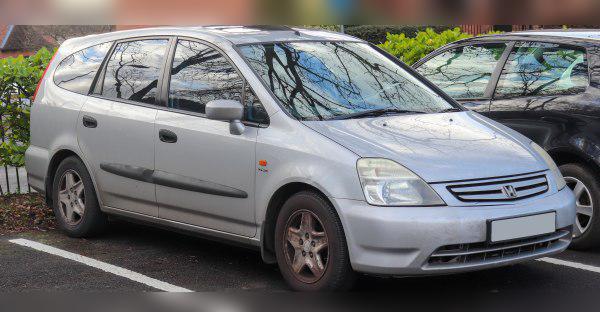
Honda K20A1 (2.0 i-VTEC) – Experiences, issues, fuel consumption and buying used
Key points in short (TL;DR)
- Reliability: The K20 series is considered one of the most reliable petrol engines ever made, provided it is regularly maintained.
- Timing drive: Uses a timing chain instead of a belt, which is very durable.
- Performance: Like every Honda, it loves high revs. Below 3,000 rpm it can feel "lazy", but wakes up once the i-VTEC system kicks in.
- Maintenance: Regular mechanical valve adjustment is crucial (it is not self-adjusting) every 40,000 km.
- Oil consumption: Expect mild oil consumption, especially if driven aggressively in the VTEC zone.
- LPG: LPG can be installed, but it requires a high-quality system and more frequent valve clearance checks than on petrol.
- Recommendation: An ideal engine for those who want reliability and don’t mind slightly higher fuel consumption in city driving.
Contents
Introduction: About the engine and the Honda Stream model
The engine designated K20A1 belongs to Honda’s legendary “K-series” of four-cylinder engines. While variants such as the K20A2 were reserved for sporty Type-R models, the K20A1 is a more “civilized” version designed for family use, comfort and longevity. It was primarily installed in the first-generation Honda Stream (and some CR-V models on certain markets), offering a balance between a solid 156 hp and everyday usability.
This is a naturally aspirated petrol engine with intelligent variable valve timing (i-VTEC). For drivers, this means the engine has “two faces”: calm and quiet at low revs to save fuel, and quite sharp once the rev needle climbs high. For an MPV like the Stream, this was an advanced powertrain for its time.
Technical specifications
| Parameter | Data |
|---|---|
| Engine code | K20A1 |
| Displacement | 1998 cc (2.0 L) |
| Power | 115 kW (156 hp) at 6500 rpm |
| Torque | 192 Nm at 4000 rpm |
| Configuration | Inline 4-cylinder, DOHC, i-VTEC |
| Injection type | MPI (Multipoint – port fuel injection) |
| Induction | Naturally aspirated |
| Camshaft drive | Chain |
Reliability and maintenance
Timing belt or chain?
The Honda K20A1 engine uses a timing chain for valve timing. This is great news for owners because there is no fixed replacement interval like with a belt. The chain is designed to last as long as the engine itself. However, “lifetime” doesn’t always mean forever – if you hear rattling on cold start or the check engine light comes on (camshaft/crankshaft sensor error), this may indicate a stretched chain, which usually happens only at very high mileage (over 250,000–300,000 km) or due to poor maintenance (irregular oil changes).
Most common issues
Although the engine is extremely robust, there are specific points to keep an eye on:
- VTEC solenoid (gasket): Oil often leaks from the VTEC solenoid gasket. The symptom is an oily engine at the back or oil loss.
- Camshafts: On early K-series engines (especially if poor-quality oil is used), the exhaust cam lobes can suffer from pitting/wear. Symptoms are metallic noise and loss of power. The K20A1 is less affected than the higher-output versions, but it’s still worth checking.
- IACV (Idle Air Control Valve): The idle control valve can get dirty, causing unstable idle (fluctuating revs). Cleaning usually solves the problem.
- Knock sensor: It can fail, which triggers the check engine light and can make the engine feel more sluggish.
Major and minor service
Since the engine has a chain, a classic “major service” (timing belt replacement) is not done. Instead, every 100,000–120,000 km it is recommended to replace the auxiliary (serpentine) belt that drives the alternator and A/C, the tensioner and the water pump as a preventive measure.
A minor service (oil and filter change) is done every 10,000 km or once a year. Do not extend the interval to 15–20 thousand km if you want to preserve the chain and the VTEC system.
Oil: quantity, grade and consumption
The engine takes approximately 4.2 litres of oil (with filter). The recommended grade is 5W-30 or 5W-40. It is important to use high-quality, fully synthetic oil.
Does it consume oil? Yes, that is characteristic of VTEC engines. Consumption of 200 ml to 500 ml per 1,000 km can be considered acceptable, especially if you often drive at high revs. If it consumes more than that, the problem may be valve stem seals or piston rings. Because of this, it is essential to check the oil level on the dipstick at least once every two weeks.
Spark plugs and valves
If you use iridium spark plugs (which are recommended), they are replaced every 100,000–120,000 km. Standard nickel plugs are replaced every 40,000 km.
Very important: This engine does not have hydraulic lifters. Valve adjustment is mandatory every 40,000 km. If this is neglected, the valves can “sink” into the seats, leading to burnt valves and an expensive cylinder head repair.
Specific parts and costs
Flywheel and clutch
In the Honda Stream, the K20A1 engine in most cases uses a solid (single-mass) flywheel. This is very good news because it significantly reduces maintenance costs compared to diesels. The clutch kit is a standard wear item and its price is average for Japanese vehicles (moderately expensive).
Fuel injection system
The engine uses a classic MPI system (Multipoint Injection). The petrol injectors are extremely reliable and rarely cause problems. There are no sensitive high-pressure pumps as with direct injection systems (GDI/FSI). If an issue does occur, it is usually due to dirt, which can be solved by ultrasonic cleaning.
Turbo, DPF, EGR, AdBlue
- Turbo: None. The engine is naturally aspirated, which means fewer parts that can fail.
- DPF / AdBlue: None. These components are related to diesel engines.
- EGR valve: Yes, it has an EGR system for exhaust gas recirculation. It can clog with soot (especially in city driving), causing jerking or a warning light on the dashboard. Cleaning is possible and not expensive.
Fuel consumption and performance
Fuel consumption
Let’s be realistic – this is a 2.0 engine in a body that is not light and doesn’t have the aerodynamics of a sports car.
- City driving: Expect between 10 and 12 litres/100 km. In heavy traffic and in winter, it can go up to 13 litres.
- Open road: At moderate speeds (80–90 km/h) consumption drops to around 7–8 litres/100 km.
- Motorway: At 130 km/h it will use about 8.5–9.5 litres/100 km.
Performance: Is the engine “lazy”?
The Honda Stream with this engine is not a race car, but it’s not slow either. However, the nature of the K20A1 is such that maximum torque (192 Nm) is delivered only at 4,000 rpm. This means that at low revs (below 2,500) the engine will feel somewhat “lazy”, especially if the car is fully loaded with passengers.
To get the power out of it, you have to press the accelerator. When i-VTEC switches the cam profile (usually noticeably after 3,500–4,000 rpm), the car pulls very convincingly for its class. Overtaking is safe, but it requires shifting down.
On the motorway at 130 km/h the engine (depending on the gearbox) spins at around 3,500–4,000 rpm, which can be a bit noisy, but the engine has no problem with that.
Additional options and modifications
LPG conversion
Is it suitable? Yes, but with great caution. Honda engines have somewhat “softer” valve seats.
If you are installing LPG: 1. A high-quality sequential system with precise mapping is mandatory. 2. It is recommended to install a valve lubrication system (“dripper” or electronic system). 3. Crucial: Valve clearance must be checked more often, ideally every 20,000–30,000 km. If this is neglected, the valves will fail very quickly.
Remap (Stage 1)
On naturally aspirated petrol engines, a “chip tune” (remap) brings minimal gains, usually 5 to 10 hp, which in practice is barely noticeable. You gain more in throttle response than in peak power. It is not really worth investing in a Stage 1 remap for this engine unless you are also doing mechanical modifications (intake, exhaust), which is rarely justified on a family MPV.
Gearbox
Manual and automatic
- Manual: Usually a 5-speed gearbox. Precise, with a short throw (typical for Honda). Very reliable. The most common issues are related to the second or third gear synchro if the car has been driven aggressively, but this is rare on the Stream. Gearbox oil (MTF) should be changed every 60,000–80,000 km.
- Automatic: With the K20A1 you often get a 5-speed (or on some markets a 4-speed) conventional automatic with a torque converter. These gearboxes are extremely durable if maintained properly. They are not the fastest shifting, but they are smooth. Failures are rare and usually the result of not changing the oil.
Gearbox service
For the automatic gearbox it is critical to change the oil every 60,000 km (or earlier). Use only genuine Honda ATF-Z1 or the newer DW-1 fluid. Universal fluids can cause jerks when shifting.
Buying used and conclusion
When buying a Honda Stream with the K20A1 engine, pay attention to the following:
- Cold start: Listen for chain rattling in the first 2–3 seconds. If it rattles longer, the chain needs replacing.
- Exhaust smoke: Have someone drive behind you while you accelerate hard (in the VTEC zone). Blue smoke means the engine is burning oil (rings or valve stem seals). Black smoke indicates poor combustion (plugs, sensors).
- Idle: The engine should idle smoothly. Fluctuating revs point to a dirty IACV or a vacuum leak.
- Oil check: Pull out the dipstick. If the level is below minimum, this indicates a careless owner, which is deadly for the VTEC mechanism.
Conclusion:
The Honda Stream 2.0 with the K20A1 engine is an excellent choice for drivers who want space and Japanese reliability and are willing to accept a somewhat “boring” interior and higher fuel consumption in city driving. With regular maintenance and quality oil, this engine will most likely outlive the rest of the car. Avoid examples with LPG installed if you don’t have proof of regular valve adjustment.