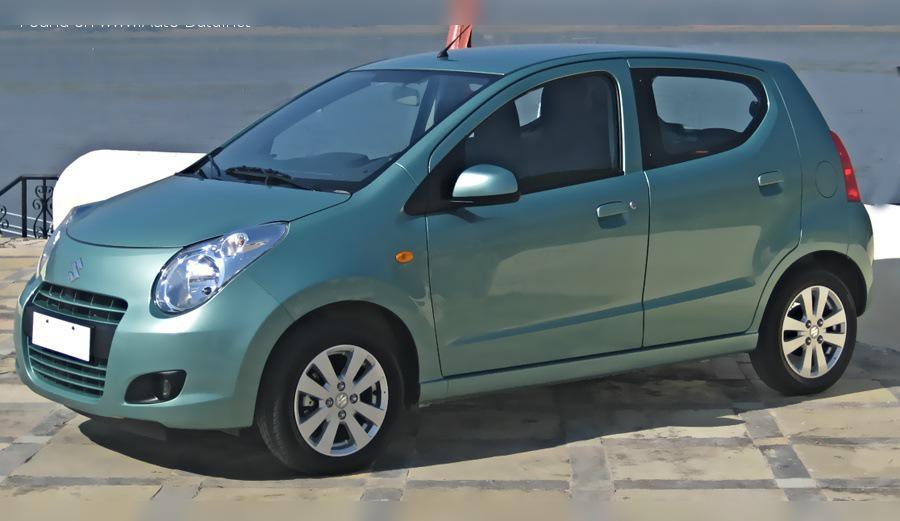
Suzuki K10B 1.0 (68 HP) – Experiences, problems, fuel consumption and used car buying tips
Most important in short (TL;DR):
- Extremely reliable naturally aspirated three‑cylinder with timing chain, designed for cheap city driving.
- No expensive components such as a dual‑mass flywheel, turbocharger or high‑pressure injectors.
- Very low city fuel consumption, rarely exceeds 6 l/100 km.
- Not intended for highway use; above 110 km/h it becomes noisy and lacks power for safe overtaking.
- Maintenance is cheap, and the biggest enemy of this engine is neglect of regular servicing by previous owners.
- Handles LPG (autogas) conversion well, but requires periodic valve clearance checks.
Contents
- Introduction: What you need to know about the K10B engine
- Technical specifications
- Reliability and maintenance
- Specific parts and costs
- Fuel consumption and performance
- Additional options and modifications
- Gearbox and drivetrain
- Buying used and conclusion
Introduction: What you need to know about the K10B engine
When you’re looking for maximum efficiency and durability in harsh urban stop‑and‑go conditions, very few engines can match Suzuki’s K10B unit. It is a compact, naturally aspirated one‑liter three‑cylinder, designed with a single goal in mind: to be cheap to produce, cheap to maintain and resistant to “abuse” in city traffic.
This engine made models such as the Suzuki Alto and Celerio popular, but it also found its way under the bonnets of partner brands, so you’ll see it in the Nissan Pixo and Opel Agila. Thanks to the low weight of the cars it’s fitted to, its modest 68 HP is quite enough for brisk acceleration up to 60 km/h, making it an ideal choice for delivery vehicles, beginners, or as a second car in the household.
Technical specifications
| Specification | Value |
|---|---|
| Displacement | 998 cc |
| Power | 50 kW (68 HP) |
| Torque | 90 Nm |
| Engine code | K10B |
| Injection type | Indirect (Multipoint - MPI) |
| Turbo / Naturally aspirated | Naturally aspirated |
Reliability and maintenance
The main advantage of this three‑cylinder is its simplicity. The engine uses a timing chain, not a timing belt. This is great news for drivers, because the chain in the K10B engine rarely causes headaches. Unlike some modern downsized engines where the chain snaps or stretches as early as 100,000 km, here, with regular oil changes, the chain usually lasts as long as the engine itself. Because of that, a classic “major service” in the sense of preventive timing replacement is not done at a fixed mileage; instead, the condition of the chain, guides and tensioner is checked at around 150,000 to 200,000 km, or when the engine starts making a specific “rattling” noise on cold start. The water pump and auxiliary belt are replaced as needed or at around 100,000 km.
As for lubrication, the K10B takes about 2.9 to 3.1 liters of oil. The manufacturer usually recommends 5W‑30, and for newer models or colder climates even 0W‑20. Oil consumption between services (every 10,000 to 15,000 km or once a year) is minimal. Topping up to 0.5 liters per 10,000 km is considered normal. If the engine consumes significantly more, it usually means the previous owner ignored oil change intervals, which leads to hardened valve stem seals or stuck piston rings.
Since this is a classic petrol engine, maintaining the ignition system is crucial. Spark plugs are replaced every 30,000 to 40,000 km if they are standard nickel plugs, while more expensive iridium plugs (often used because access is tricky on some models) can last up to 60,000 km. If spark plug replacement is neglected, the engine will run rough, be hard to start, and ignition coils may fail (each cylinder has its own coil).
The most common failures are mostly peripheral: water pump leaks, minor oil seepage from the valve cover, or worn engine mounts (which shows up as strong vibrations at idle, given that a three‑cylinder is inherently unbalanced).
Specific parts and costs
The biggest savings when owning this engine come from what it doesn’t have. Maintenance is very cheap (depends on the market).
- Dual‑mass flywheel: This engine uses only a solid flywheel. In other words, there are no expensive dual‑mass flywheel replacements here.
- Fuel injection: The K10B uses simple MPI (multipoint) indirect injection. The injectors operate at low pressure, are extremely durable and rarely get dirty unless you use very poor‑quality fuel. Ultrasonic cleaning is cheap, and used injectors are easy to find.
- Turbocharger: The engine is naturally aspirated. No worries about turbo cooling, “siren” noises or costly rebuilds.
- DPF, AdBlue and EGR: As a petrol engine, it has no DPF filter or AdBlue system. Certain versions are equipped with an EGR valve to meet Euro emission standards. The EGR can get clogged by frequent low‑rpm city driving, which causes rough idle, fluctuating revs and a “Check Engine” light. Cleaning usually solves the problem.
Fuel consumption and performance
City driving is this engine’s natural habitat. Real‑world city consumption is between 5 and 6.5 l/100 km, depending on traffic and driving style. Due to the low torque (90 Nm), you always need to keep the revs slightly higher to keep up with traffic, but this doesn’t drastically affect fuel consumption.
Is the engine “sluggish”? In bodies weighing around 850–900 kg (Suzuki Alto, Celerio), the engine is quite lively up to 60 km/h. However, the moment four people get in the car or you switch on the air conditioning, you’ll feel a dramatic drop in power. The A/C compressor literally “steals” some horses, so uphill overtaking with the A/C on becomes a serious challenge.
On the highway, all its weaknesses show. The aerodynamics of city cars and short gearbox ratios take their toll. At 130 km/h, the engine spins at a high 3,500 to 4,000 rpm (depending on the gearbox). At that speed, the cabin is very noisy and fuel consumption jumps above 7 l/100 km. The ideal cruising speed for this unit is between 100 and 110 km/h.
Additional options and modifications
For drivers who want to cut running costs to the minimum, LPG (autogas) conversion is a frequent topic. The K10B can be converted to LPG relatively easily thanks to its MPI injection. However, there is one important technical detail: this engine does not have hydraulic valve lifters. Running on LPG raises combustion temperatures, which can lead to faster valve seat recession. If you install LPG, you must check and mechanically adjust valve clearances every 40,000 to 50,000 km. Installing a valve lubrication system (so‑called “drippers” or Flashlube) is also strongly recommended.
As for remapping (Stage 1), the answer is short and clear: don’t waste your money. Software tuning of a small naturally aspirated engine without a turbo can bring at most 3 to 5 horsepower, which you won’t notice in real‑world driving. The K10B is not a performance base.
Gearbox and drivetrain
Several transmission options were paired with the K10B, which significantly affects driving experience and maintenance costs:
- 5‑speed manual gearbox: By far the most common choice. It’s robust, but the synchros for first gear and reverse can be a bit rough, so sometimes you need to “double‑clutch” to get the lever in smoothly. A clutch kit (pressure plate, disc, release bearing) usually lasts over 100,000 km, even in pure city use. Clutch replacement is very cheap (depends on the market) because, as mentioned, there is no dual‑mass flywheel. The oil in the manual gearbox should be changed preventively every 60,000 km.
- Conventional automatic gearbox (4‑speed): This torque‑converter automatic is found in older models (Pixo, Alto). It’s very slow, increases fuel consumption by about 1 liter and further hurts performance, but it is almost indestructible if you change the oil every 60,000 km.
- AGS / AMT gearbox (robotized manual): Found in newer models (Celerio, S‑Presso). It is essentially a manual gearbox operated by electronics (it engages the clutch and shifts by itself). It’s jerky at low speeds and in traffic jams it wears the clutch disc faster than a careful driver with a manual would. Actuator failures are possible, and periodic calibration is recommended.
Buying used and conclusion
What to look out for when buying?
When viewing a car with this engine, start it completely cold first. Listen to the right‑hand side of the engine. If you hear a sharp metallic rattle that doesn’t disappear after a few seconds, the timing chain is stretched and due for replacement. Inspect the engine block and valve cover from above and below – slight oil misting is not a big deal, but if oil is clearly dripping, be cautious. Be sure to press the clutch pedal; it should be light. If it’s heavy or bites right at the top, a clutch kit replacement is coming.
Also, switch on the A/C while the engine is idling. The revs should rise slightly and then stabilize. If the engine starts shaking heavily or feels like it’s about to stall, the problem may be in the idle control valve, a dirty throttle body or a clogged EGR valve.
Who is the K10B for?
The Suzuki K10B is a gem for those who see a car purely as a means of getting from point A to point B in an urban environment. Its old‑school mechanics forgive mistakes, repair costs won’t force you to take out a loan, and fuel consumption is tiny. On the other hand, if you regularly drive on the highway, have a family with lots of luggage or enjoy dynamic driving, this three‑cylinder will drive you crazy with its noise and lack of power. It is a city warrior in the purest sense of the word.