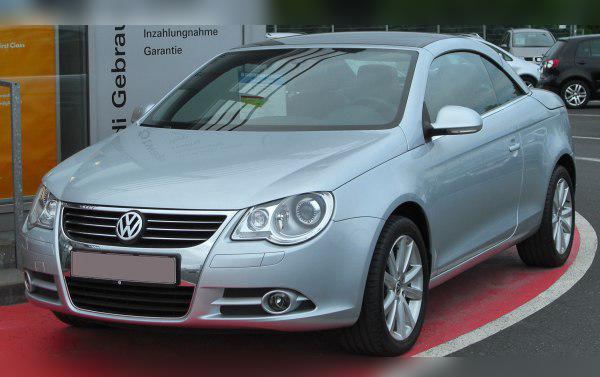
VW 3.6 FSI V6 (CDVA) – Experiences, problems, fuel consumption and used car buying guide
The CDVA engine represents the last gasp of true automotive romance in Volkswagen’s lineup for compact models. It is a naturally aspirated 3.6‑liter VR6 engine which, in this specific 260 hp version, was installed in the Volkswagen Eos. Unlike its more powerful sibling in the Passat R36 (300 hp), this engine is slightly “detuned” to better suit the character of a convertible and front‑wheel drive, but it still offers that recognizable throaty sound and linear power delivery.
This is not an engine for everyone. It is aimed at enthusiasts who value sound and torque more than low fuel consumption. In the rest of the text we analyze in detail what awaits you if you decide on this engineering gem, from timing chain maintenance to oil consumption.
Key points (TL;DR)
- Great sound and response: Naturally aspirated engine with linear power and the distinctive VR6 sound.
- Sensitive timing chain: Even though it uses a chain, it is not lifetime. Replacement is expensive because it is located at the back of the engine (next to the gearbox).
- Direct injection (FSI): Prone to carbon buildup on intake valves, which gradually reduces power.
- DSG gearbox is mandatory: This engine comes exclusively with an automatic gearbox that requires regular maintenance.
- High fuel consumption: In the city you can expect double‑digit figures, without exception.
- Recommendation: Buy only examples with a well‑documented service history, especially related to the gearbox and timing chain.
Contents
- Technical specifications
- Reliability and maintenance
- Specific parts (costs)
- Fuel consumption and performance
- Additional options and modifications
- Gearbox
- Buying used and conclusion
Technical specifications
| Specification | Data |
|---|---|
| Engine code | CDVA |
| Displacement | 3597 cc (3.6 liters) |
| Configuration | VR6 (narrow V angle of 10.6 degrees) |
| Power | 191 kW (260 hp) at 6000 rpm |
| Torque | 350 Nm at 2400–4000 rpm |
| Injection system | FSI (direct petrol injection) |
| Induction type | Naturally aspirated (no turbo) |
Reliability and maintenance
Chain or belt?
The CDVA 3.6 FSI engine uses a timing chain for valve timing. This is a key point of this engine. Although it is theoretically “maintenance‑free”, in practice that is not the case. The chain is located at the back of the engine (between the engine and gearbox), which means that any intervention on it requires removing the engine or gearbox from the car. This drastically increases labor costs.
Most common failures
This powerplant is mechanically robust, but it has a few specific weak points:
- Timing chain stretch: Usually occurs after 150,000–200,000 km. Symptoms are rattling on cold start (a metallic noise lasting a few seconds) or the “Check Engine” light due to desynchronization between the camshaft and crankshaft sensors.
- PCV valve (oil separator): The membrane in the PCV valve often tears. Symptoms are rough idle, increased oil consumption and a characteristic “whistling” sound from the engine bay.
- Carbon buildup: Due to direct injection (FSI), fuel does not “wash” the intake valves. Over time, a layer of carbon forms that chokes the engine, reduces power and increases fuel consumption. It is solved by mechanical cleaning (walnut shell blasting) every 80,000–100,000 km.
- Ignition coils: They can fail, causing the engine to run on fewer cylinders (misfire, jerking, loss of power).
Service intervals and oil
Minor service is recommended every 10,000 km up to a maximum of 15,000 km. Forget about “Long Life” intervals of 30,000 km if you want to preserve the timing chain. The engine takes about 5.5 liters of oil (check precisely by VIN, it may vary by +/- 0.2 l). The recommended grade is 5W‑30 or 5W‑40, with mandatory compliance with VW standard 504.00/507.00.
The major service (in terms of chain replacement) has no fixed interval; it is done “as needed”, i.e. when noises are heard or diagnostics show deviations. However, the auxiliary (serpentine) belt, tensioners and water pump should be regularly checked and replaced at around 100,000–120,000 km.
Oil consumption and spark plugs
Oil consumption is present on FSI engines. It is considered “normal” for the engine to consume about 0.5 to 1 liter per 2,000–3,000 km with more spirited driving. If it uses a liter per 1,000 km, that points to an issue with the piston rings or the PCV valve.
Spark plugs on this engine are replaced every 60,000 km (some recommendations say 90,000 km, but due to fuel quality and the FSI system, 60k is optimal). Use only iridium or platinum spark plugs recommended by the manufacturer (NGK or Bosch).
Specific parts (costs)
Dual‑mass flywheel: Yes, this engine in combination with the DSG gearbox does have a dual‑mass flywheel. It serves to absorb vibrations from the powerful V6 engine and protect the gearbox. Its lifespan is usually around 150,000–200,000 km, and replacement is quite expensive (very expensive, depending on the market).
Injection system: It uses an FSI system with high‑pressure injectors that spray directly into the cylinder. The injectors are generally reliable, but sensitive to poor fuel quality. Replacing a single injector can be costly. The high‑pressure fuel pump (HPFP) is also a critical component, but on the 3.6 engines it is more reliable than on the older 2.0 FSI units.
Turbo and EGR/DPF:
Turbo: This engine does not have a turbocharger. That is one less thing to worry about (no turbo rebuilds, no intercooler, no boost leaks).
DPF/AdBlue: Being a petrol engine, it does not have a DPF filter and does not use AdBlue.
EGR: A classic EGR valve often does not exist as a physical component like on diesels; instead, exhaust gas recirculation is achieved via variable valve timing (internal EGR). Still, the crankcase ventilation system (PCV) takes over the role of the main emissions‑related component and is the one that most often fails/clogs.
Fuel consumption and performance
City driving: To be realistic – this is not an economical engine. In heavy city traffic, real‑world consumption ranges from 12 to 16 liters per 100 km. In winter and on short trips it can go even higher.
Performance and “laziness”: Is the engine lazy? Absolutely not. Although the Eos is a heavy car (due to the roof mechanism and chassis reinforcements), 260 hp and 350 Nm of torque available from low revs make driving extremely smooth. The engine pulls linearly, with no “turbo lag”, and has power at any moment. It is not as explosive as modern turbo engines, but it is relentless.
Highway: This is the natural habitat of this engine. At 130 km/h the engine “cruises” at relatively low revs (thanks to the 6th gear of the DSG), usually around 2,800–3,000 rpm. In that case, fuel consumption can drop to a reasonable 8–9.5 l/100 km. Overtaking is routine and does not require any effort.
Additional options and modifications
LPG conversion: Is it possible? Yes, but it is complicated and expensive. Since this is a direct‑injection engine (FSI), you cannot install a simple sequential LPG system. You need either a system that injects liquid LPG directly through the petrol injectors (the best but most expensive option) or a system that “adds” petrol along with LPG (e.g. 20% petrol, 80% LPG) to cool the injectors. Installation is very expensive (depends on the market) and the cost‑effectiveness is questionable unless you cover a very high annual mileage.
Remapping (Stage 1): Since the engine is naturally aspirated, gains are minimal. With a Stage 1 remap you can get about 10 to 15 hp and a slightly better throttle response. The speed limiter is often removed and the gearbox map is adjusted for faster shifts, which contributes more to the feeling of speed than to actual power increase. Do not expect a dramatic difference like on turbo engines.
Gearbox
With the CDVA engine in the Eos, a 6‑speed DSG automatic gearbox (code DQ250) was fitted as standard. A manual gearbox with this engine in the Eos is extremely rare or non‑existent in most markets.
DSG maintenance: The oil and filter in the DSG gearbox MUST be changed every 60,000 km. If this is neglected, the mechatronics (the brain of the gearbox) or the clutch packs will fail.
Failures and symptoms:
- Mechatronics: The most expensive failure. Symptoms are jerking when setting off, harsh shifts (especially when downshifting) or the gearbox going into “safe mode” (flashing gear indicator).
- Clutches: The DQ250 has “wet” clutches that are durable but do wear out. If revs flare while the car does not accelerate proportionally, the clutches are near the end of their life.
- Flywheel: As mentioned, you will hear a metallic knocking at idle that disappears or changes when the gearbox is put into ‘D’ or ‘R’.
The cost of replacing the clutch pack and flywheel is high (depends on the market), so checking the gearbox before purchase is critical.
Buying used and conclusion
Before buying an Eos with the 3.6 engine, pay attention to the following:
- Cold start: Insist that the engine is completely cold. Start it and listen to the chain. If rattling lasts longer than 2–3 seconds, the chain is due for replacement (negotiate a significant price reduction).
- DSG test: The gearbox must shift smoothly, both when cold and hot. Try starting uphill without throttle (the car should not roll back excessively or jerk).
- Oil leaks: Inspect the joint between the engine and gearbox.
- Roof: On the Eos, be sure to check the operation of the roof mechanism and whether water leaks into the cabin (even though it is not part of the engine, this is the most expensive part of the car).
Conclusion
The Volkswagen Eos 3.6 V6 is a future classic. The CDVA engine is robust, powerful and offers a fantastic sound experience that you simply do not get in modern cars anymore. However, this is a pricey toy. Fuel consumption is high, and potential failures of the timing chain and gearbox can cost as much as half the value of the car. It is intended for drivers who want “sleeper” performance and the pleasure of open‑top motoring, and who have the budget to maintain it properly.