Key points in short (TL;DR)
- Exceptional cost-efficiency: The CNG (methane) setup makes this engine one of the cheapest per kilometer to run, ideal for taxi use and delivery vehicles.
- Complex technology: It features a VTG turbocharger (variable turbine geometry), which is rare for petrol/TGI engines, and operates in the Miller cycle for better efficiency.
- Small petrol tank: This is primarily a CNG vehicle. The petrol tank is an “emergency” type (around 9 liters), which can be a problem in regions with a poor CNG station network.
- Timing belt reliability: The engine uses a timing belt with a long replacement interval, but it requires quality maintenance.
- Gearbox as a weak point: If paired with a DSG gearbox (dry clutch), it requires caution and a thorough check of the mechatronics and clutch condition.
- Performance under load: With 131 hp and 200 Nm, the engine is adequate for an empty Caddy, but under full load in the Maxi version it can feel sluggish on inclines.
Contents
1.5 TGI (EA211 evo) – Factory methane engine for a new era
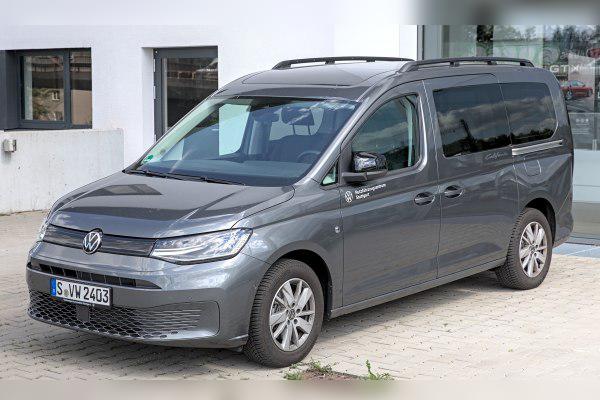
The EA211 evo (engine code DHFA) engine is Volkswagen’s answer to increasingly strict emission standards, but without switching to full electrification. This is a 1.5‑liter turbo engine factory‑adapted to run on compressed natural gas (CNG), primarily installed in commercial and family vehicles such as the fifth‑generation VW Caddy and Caddy Maxi.
Unlike aftermarket LPG or CNG conversions, this engine was designed from the outset to withstand the higher thermal loads associated with CNG. Pistons, valves and valve seats are reinforced. It is a workhorse designed to cover high mileages with minimal fuel costs, but that saving comes at the price of more complex maintenance compared to simple naturally aspirated petrol engines.
Technical specifications
| Characteristic | Data |
|---|---|
| Displacement | 1498 cc |
| Power | 96 kW (131 hp) |
| Torque | 200 Nm at 1400–4000 rpm |
| Engine code | DHFA (EA211 evo series) |
| Fuel type | CNG (methane) / Petrol (reserve) |
| Injection | Direct injection (TSI/TGI) |
| Charging | VTG turbocharger + intercooler |
| Emissions | Euro 6d (depending on model year) |
Reliability and maintenance: What to expect?
Timing: Belt or chain?
The 1.5 TGI from the EA211 evo series uses a timing belt. This is good news, as older chain‑driven TSI engines proved problematic. The belt on these engines is very durable.
Service intervals
The manufacturer often lists optimistic intervals for the major service (up to 210,000 km or a time limit), but real‑world experience and common sense call for caution.
Recommended timing service: At around 150,000 to 180,000 km or every 8–10 years (whichever comes first). The full timing kit and water pump must be replaced.
Spark plugs: On CNG engines, spark plugs are under greater stress due to higher combustion temperatures and a harder‑to‑ignite mixture. Replace them more frequently than on a pure petrol engine, ideally every 30,000 to 45,000 km. Use only plugs specified for TGI engines (usually iridium).
Oil and oil consumption
This engine holds approximately 4.3 liters of oil. Due to the specifics of running on methane and the high temperatures, as well as the VTG turbo, oil quality is crucial.
Viscosity: VW recommends 0W-20 (VW 508.00 standard) for “evo” engines for efficiency, although in hotter climates and for heavily loaded vehicles many mechanics prefer 5W-30 (VW 504.00). However, always consult the factory manual, as the VTG turbo can be sensitive to viscosity.
Oil consumption on the 1.5 TGI is not alarming like on the old 1.8 or 2.0 TSI engines. Consumption of up to 0.5 liters per 5,000 km is acceptable, especially with motorway driving.
Most common issues
- Carbon buildup: As a direct‑injection engine, the valves are not “washed” by fuel. Over time, deposits form on the intake valves, causing rough running and loss of power.
- Gas pressure regulator: Although less common than on older models, the electronic methane pressure regulator can fail, preventing operation on CNG.
- VTG turbo actuator: The variable geometry mechanism can stick due to soot, causing “safe mode” or power loss.
- Cooling system failures: The water pump (part of the engine’s thermal management system) can start leaking prematurely.
Specific components and costs
Dual‑mass flywheel
Yes, this engine generally uses a dual‑mass flywheel. Although it runs on petrol/methane, the torque and the need for smooth running at low revs (Miller cycle) require a dual‑mass flywheel, especially on manual‑gearbox models. On DSG versions, a flywheel is also present and specific to that transmission type. Replacement cost is high (varies by market).
Injection system
The system uses direct injection. The petrol injectors are high‑pressure and sensitive to poor‑quality petrol (which can slosh around in the tank for months because it is rarely used). The methane injectors are separate and located on the intake manifold (MPI principle for gas) or also direct, depending on generation, but on the 1.5 TGI they are integrated into a complex system. Maintaining the injection system is more expensive than on ordinary engines.
Turbocharger
The engine has a single turbocharger, but it is technologically advanced – it uses VTG (Variable Turbine Geometry) technology, previously reserved only for diesels and Porsche petrol engines. This provides excellent throttle response, but overhauling such a turbo is more complex and more expensive. Service life is long (over 200,000 km) with regular oil changes and proper cooldown after driving.
DPF, EGR and AdBlue
This engine DOES NOT have a DPF (as it is not a diesel) and DOES NOT use AdBlue.
However, it does have a GPF (Gasoline Particulate Filter). Since methane burns extremely cleanly, the GPF rarely clogs compared to a diesel DPF.
An EGR valve is present and serves to recirculate exhaust gases to reduce NOx emissions and combustion temperatures.
Fuel consumption and performance: Real‑world in a Caddy
Real‑world consumption
This is where the engine shines. Consumption is measured in kilograms (kg) for CNG.
- City driving: Expect around 5.0 to 6.0 kg/100 km.
- Open road: It can drop to 3.8 to 4.5 kg/100 km with gentle driving.
- Range: With full methane tanks (usually around 34–37 kg capacity in the Caddy Maxi version), the real‑world range is between 400 and 550 km, plus the small petrol tank for another 100–120 km or so.
Is the engine “lazy”?
With 131 hp and 200 Nm, this engine is “on the edge” for a vehicle the size and weight of a Caddy Maxi, especially when loaded (Cargo version).
In the city it is perfectly adequate thanks to the turbo delivering torque early. However, on open roads and uphill, if the vehicle is fully loaded, the lack of torque will be noticeable. It is not a sports car, it is a work tool. Overtaking requires planning and a lower gear.
Motorway behavior
At 130 km/h the engine runs smoothly, thanks to the 6‑speed manual or 7‑speed DSG gearbox. Revs are usually around 2,600–2,800 rpm. The cabin is quieter than in TDI versions, but the Caddy’s aerodynamic noise dominates.
Additional options and modifications
LPG conversion?
For this engine, the question is pointless. It already has a factory CNG (methane) system. Installing LPG is technically senseless and not cost‑effective, as you are already running on the cheapest possible fuel. There is also no space for an LPG tank, because the underbody is occupied by the methane tanks.
Chiptuning (Stage 1)
The engine can be tuned via software (remap).
Stage 1 potential: Typically around 150–155 hp and 240–260 Nm can be achieved.
Warning: Although possible, it is not recommended lightly. Methane burns at higher temperatures. Increasing turbo pressure and power further raises combustion temperatures, which can shorten the life of the valves and turbo. If you decide to do it, only use reputable tuners.
Gearbox: Manual and DSG
With the 1.5 TGI you get two options:
- 6‑speed manual: Precise, robust and cheaper to maintain. The most common issues are related to the clutch kit and dual‑mass flywheel. Replacing the clutch kit with the flywheel is a moderately expensive job (varies by market). Gearbox oil should be changed preventively at 100,000 km, even though VW often claims it is “lifetime”.
- 7‑speed DSG (DQ200): This is a gearbox with a dry clutch. It is known for fast shifting but also for its sensitivity.
- Failures: Mechatronics issues and clutch wear in stop‑and‑go city driving.
- Servicing: Although it is a “dry” gearbox, there is oil in the gearset and mechatronics. It is recommended to check and replace the fluid in the mechatronics where possible (a specific procedure).
- Repair cost: Very expensive (varies by market).
Buying used and conclusion
What to check before buying?
- Tank certification: Check whether the CNG tanks are still valid and when the certification expires. Replacing tanks or re‑certification can be administratively and financially demanding. Steel tanks have a service life (usually 20 years), while composite tanks may be subject to different rules.
- Running on petrol: Always test the car when cold. It must start on petrol (if there is enough fuel and the temperature is low) and run smoothly. If it misfires when cold, the petrol injectors may be clogged.
- Noises when switching fuels: Listen for the “click” when the engine switches from petrol to methane. It should be imperceptible while driving.
- Rear suspension condition: Due to the weight of the tanks, the Caddy’s rear axle is under higher load.
Conclusion: Yes or no?
The VW Caddy 1.5 TGI is an ideal choice for companies, taxi drivers and families who cover high mileages and have access to CNG stations. The fuel savings are huge and will quickly offset the potentially higher maintenance costs of specific components.
However, if you live in an area without a CNG station, this car is a big NO, because with a 9‑liter petrol tank you will not get far. Also, if you often tow heavy trailers uphill, a TDI diesel is still a better choice due to its higher torque.