488 Magnum 8.0 V10 Engine: Experiences, Issues, Fuel Consumption and Buying Used
Key points (TL;DR)
- Brutal towing power: A massive V10 petrol engine designed primarily for hauling heavy loads and towing huge trailers, not for racing.
- Fuel consumption like a boat: In city driving and under load it easily gulps over 25–30 l/100 km. LPG conversion is often the only salvation.
- Timing chain drive: There is no classic major service with a timing belt; the chain is extremely durable.
- Automatic transmission as a weak point: The petrol block is practically indestructible, but the automatic transmission (47RE) requires careful maintenance and often fails under heavy load.
- Typical issues: Cracking exhaust manifolds from heat and failing intake plenum gasket, which leads to oil consumption.
- No expensive emission systems: Forget about DPF, AdBlue and costly dual-mass flywheels – this is old-school mechanics.
Contents
- Introduction: Eight-liter monster
- Technical specifications
- Reliability and maintenance
- Specific parts and costs
- Fuel consumption and performance
- Additional options and modifications (LPG and Chip Tuning)
- Gearbox and powertrain
- Buying used and conclusion
Introduction: Eight-liter monster
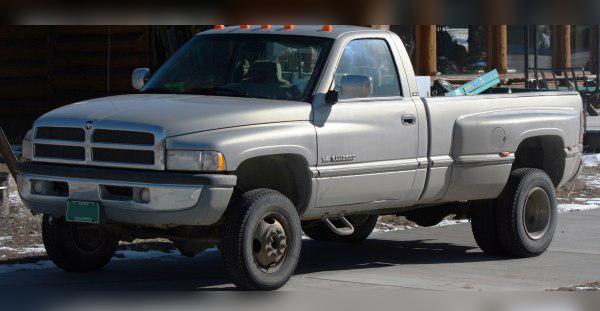
When American engineers in the late nineties were thinking about how to offer a proper petrol alternative to the indestructible Cummins diesel, the 488 Magnum (8.0 V10) was born. Installed mainly in heavy-duty trucks such as the Dodge Ram 2500HD and 3500 (BR/BE generation), this engine shares some architecture with the famous Dodge Viper, but that’s where the similarities end. While the Viper’s V10 was aluminum and built for speed, the Magnum V10 is a cast-iron block built to be a “mule.” It’s expected to push huge bodies with dual rear wheels (DRW) and tow several tons on the hitch, all with a characteristic deep, grumbling sound.
Technical specifications
| Parameter | Value |
|---|---|
| Engine displacement | 7997 cc |
| Power | 224 kW (300 hp) |
| Torque | 610 Nm |
| Engine codes | Magnum 8.0L V10 (Depends on year and market) |
| Injection type | MPI (Multi-Point Injection – into the intake manifold) |
| Aspiration | Naturally aspirated |
Reliability and maintenance
Does this engine have a timing belt or a chain?
This unit uses a massive timing chain. Since it’s a heavy-duty workhorse with relatively low operating rpm, the chain is practically indestructible and rarely needs replacement within the normal service life of the vehicle. There’s no risk of a timing belt snapping and destroying your valves.
What are the most common failures on this engine?
The engine block itself, pistons and crankshaft can cover hundreds of thousands of kilometers without issues, but the peripherals can cause headaches. The most well-known problem is cracking exhaust manifolds. Due to the enormous temperatures produced by 10 cylinders under load, the cast-iron exhaust manifolds often crack or break off bolts from the cylinder head. The symptom is a distinct “ticking” from the engine bay while the engine is cold. Another common issue is the so-called “plenum gasket leak” (leak of the intake plenum bottom plate gasket). Because of different thermal expansion of materials, the gasket fails, the engine starts sucking oil from the sump directly into the intake, which leads to detonation (pinging) and high oil consumption.
At what mileage is the major service done?
Because it has a chain, there is no classic “major service”. Maintenance comes down to checking and replacing the accessory belts, idlers, tensioners and water pump every 100,000 to 120,000 km. Due to the age of these vehicles, it is highly recommended to flush the cooling system, as a clogged radiator quickly leads to overheating.
How many liters of oil does this engine take and which grade is recommended?
The sump of this giant holds about 6.6 liters of oil (including the filter). At the time, the manufacturer recommended 10W-30 or 5W-30. Today, the important thing is to use a quality synthetic or semi-synthetic oil that can handle high operating temperatures well, especially if you frequently tow a trailer.
Does it consume oil between services?
Yes, huge engines of this design consume a certain amount of oil by design. A loss of around 0.5 to 1 liter per 5,000 km is considered normal due to evaporation and the large cylinder size. However, if the engine suddenly starts burning a lot of oil and there are no external leaks on the ground, the culprit is almost certainly the aforementioned intake plenum gasket.
At what mileage should the spark plugs be replaced?
Since this is a classic petrol engine with 10 cylinders, you replace exactly 10 spark plugs. If you use standard copper plugs, replacement is done at around 50,000 km. If you install quality iridium plugs, the interval can be extended to 90,000–100,000 km. Beware: access to the rear plugs, close to the cabin, is a real nightmare for mechanics!
Specific parts and costs
Does the engine have a dual-mass flywheel?
No, in versions with a manual gearbox this engine uses a massive solid flywheel. It is designed for harsh use and does not have delicate components that dampen vibrations in the way European passenger diesels do. There are no expensive dual-mass flywheel repairs.
What kind of injection system does it have and are the injectors problematic?
It uses sequential electronic injection (MPI) into the intake manifold. The petrol injectors are generally very reliable and long-lasting. If issues occur, they are usually due to dirt build-up from poor-quality fuel or long periods of sitting. Removing and ultrasonic cleaning usually solves the problem.
Does the engine have a turbocharger?
No. This is a pure, raw naturally aspirated engine. No turbo lag, no expensive turbocharger overhauls. Its 610 Nm of torque comes solely from the gigantic 8-liter displacement.
Does this model have a DPF or EGR valve, and what about the AdBlue system?
Since this is a petrol engine from the nineties/early 2000s, it has no DPF and no AdBlue system. Those systems are reserved exclusively for newer diesels. As for the EGR valve (Exhaust Gas Recirculation), it exists on certain versions of this engine (depending on the target market and its emission standards). If fitted, it can get clogged with soot, causing rough idle, but it is relatively easy to clean.
Fuel consumption and performance
What is the real fuel consumption in city driving?
Prepare for a shock. An eight-liter monster installed in a pickup weighing close to 3 tons means that city fuel consumption is rarely below 25–30 liters of petrol per 100 km in stop-and-go traffic. With the A/C on and under load, these numbers easily go even higher.
Is this engine “lazy” for the weight of the vehicle it’s installed in?
It is absolutely not lazy in response, but don’t expect sports-car acceleration. Its 300 hp and massive 610 Nm pull progressively like a locomotive. It is designed to have huge pulling power right from the bottom end (low-end torque). So, you won’t be winning traffic-light races, but you’ll be able to tow a boat or an excavator uphill without the engine even “noticing” the effort.
How does the engine behave on the highway and at what rpm does it cruise at 130 km/h?
The aerodynamics of a Dodge Ram with the 8.0 engine are like pushing a wall through the air. At 130 km/h the engine runs completely relaxed, usually between 2,000 and 2,300 rpm (depending on the differential gear ratio). At that speed the engine itself is fairly quiet, but wind noise in the cabin is significant. Highway fuel consumption hardly drops below 18–20 l/100 km.
Additional options and modifications
Is this engine suitable for LPG (autogas) conversion?
Yes, LPG conversion is highly recommended for anyone who wants to soften the brutal petrol costs. The engine handles LPG very well (there is no direct injection to complicate things). However, due to the 10 cylinders and 300 hp, you need a top-quality sequential system with an extremely strong vaporizer (often two vaporizers are installed) to keep up with fuel demand when you floor the throttle. Installing such a system is quite expensive (depends on the market).
How far can this engine be safely tuned with a “Stage 1” chip?
Since this is a naturally aspirated petrol engine with huge displacement and conservative factory maps, a classic Stage 1 chip tune does not bring spectacular gains in horsepower (you’ll get about 15–25 hp more). The biggest advantage of ECU remapping on this model is removing the factory speed limiter, improving shift points on the automatic transmission (better response), and adjusting fuel mixture if you’ve installed a freer-flowing intake and exhaust.
Gearbox
Which manual and automatic transmissions are paired with this engine?
The vast majority of models on the market came with the robust 4-speed automatic transmission designated 47RE. If you’re looking for a manual option (which is much rarer), there is the fantastic, “truck-like” 5-speed manual gearbox known as the NV4500.
What are the most common failures of the manual and automatic transmissions?
- Automatic 47RE: This is definitely the weak link of the entire drivetrain. Too much torque from the engine, especially when towing, often leads to slipping of the internal clutches, overheating of the fluid and failure of the valve body. Repairs are expensive.
- Manual NV4500: Physically massive and almost indestructible, except for one well-known flaw – the 5th gear nut tends to back off, which leads to loss of 5th gear while driving. Fortunately, there are aftermarket solutions for permanently securing this nut.
Does this model have a dual-mass flywheel and how much does a clutch replacement cost?
As mentioned, the NV4500 manual uses a solid flywheel. The clutch kit (disc, pressure plate, release bearing) has to be heavy-duty because of the 610 Nm and the enormous loads being towed. The kit itself is generally expensive (depends on the market), but it is replaced very rarely, provided the driver doesn’t “burn” the clutch with improper starts on an uphill with a trailer.
At what mileage should the gearbox be serviced and the oil changed?
For the automatic transmission, regular service (ATF fluid change, filter replacement and cleaning the magnets in the transmission pan) is MANDATORY every 40,000–50,000 km. Also, the 47RE requires periodic band adjustment so it can shift smoothly without slipping. The manual gearbox requires a specific synthetic oil (Castrol Syntorq LT), which is usually changed at 80,000–100,000 km, depending on operating conditions.
Buying used and Conclusion
What should you check before buying?
- Noise from the engine bay: If you hear loud ticking or clattering when you start it, the exhaust manifold bolts have most likely snapped.
- Oil traces in the intake: Remove the intake hose and look inside. If it’s oily and sticky, that’s a sign the plenum gasket has failed. The engine will consume oil and lose power.
- Condition of the transmission fluid: Pull out the automatic transmission dipstick. The fluid must be bright red (or slightly pink). If it’s dark brown and smells burnt, walk away from that vehicle – an extremely expensive overhaul is waiting for you.
- Front suspension: The weight of the entire V10 block and additional mass puts a lot of stress on the front suspension (tie rods, ball joints, bushings). Be sure to check for play in the steering, as the steering box and linkage on older Dodge trucks often suffer from the so-called “death wobble” (uncontrollable front-end shaking at certain speeds).
Conclusion: Who is the 488 Magnum 8.0 V10 for?
This engine is not designed for posing in city traffic, nor even for everyday commuting, given that fuel costs will bankrupt you. However, if you need a serious work vehicle for towing car haulers, construction machinery or boats, and for whatever reason you don’t want (or don’t like) expensive diesel technology, the V10 Magnum is true “old-school” mechanics. With a properly installed LPG system you get an indestructible machine, cheaper to maintain than diesels from the same era, provided you reserve a budget for maintaining the automatic transmission.