F23 Engine
- Engine
- 2254 cm3
- Aspiration
- Naturally aspirated engine
- Fuel
- Petrol (Gasoline)
- Fuel injection system
- Multi-port manifold injection
- Power
- 160 hp @ 5700 rpm
- Torque
- 214 Nm @ 4900 rpm
- Cylinders
- 4
- Valves
- 16, 4 per cylinder
- Cylinders position
- Inline
- Valvetrain
- OHC
- Oil capacity
- 4.3 l
- Coolant
- 5.4 l
# Vehicles powered by this engine
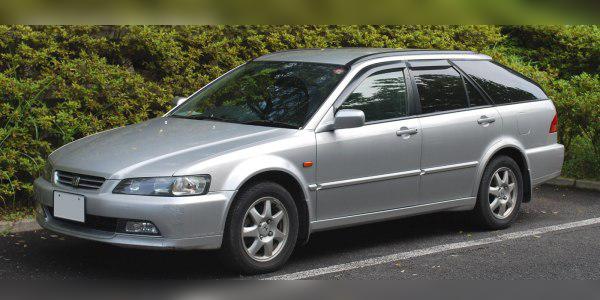
Honda F23 2.3 VTEC: Experiences, problems, fuel consumption and buying tips
Key points (TL;DR)
- Reliability: Legendary Honda durability, provided the oil is changed regularly.
- Oil: These engines tend to "drink" oil, especially in VTEC mode. Checking the oil level every 1,000 km is a must.
- Timing service: Uses a timing belt, not a chain. There is also a separate balance shaft belt that must not be forgotten.
- Gearbox: The manual is virtually indestructible, but automatic transmissions from this era are a weak point and require caution.
- LPG (Autogas): Handles LPG very well, but requires regular (mechanical) valve adjustment.
- Performance: It’s not a race engine, but the 2.3-liter displacement provides good torque for the heavy wagon body.
- Conclusion: If you find an example that hasn’t been "killed" by poor maintenance, this is a fantastic old-school engine.
Contents
Introduction: The last Mohican of the SOHC VTEC era
The engine designated as F23 (most commonly from the F23A or F23Z series) represents the peak of development of Honda’s single overhead cam (SOHC) four-cylinders before the K-series took over. It was primarily installed in the sixth-generation Honda Accord (1997–2002), including the spacious Wagon (estate) version that is the subject of this text. With a displacement of 2.3 liters, this engine was designed to offer a compromise between the power of a V6 and the efficiency of an inline four. Unlike the high-revving engines from the Civic Type R models, the F23 was made for comfortable cruising, but thanks to the VTEC system, it can bare its teeth when you press the accelerator to the floor.
Technical specifications
| Parameter | Value |
|---|---|
| Engine displacement | 2254 cc (2.3 L) |
| Power | 118 kW (160 hp) |
| Torque | 214 Nm |
| Engine codes | F23A1, F23Z5 (depends on market – JDM/US/EU) |
| Configuration | I4, SOHC VTEC (16 valves) |
| Fuel injection system | MPI (Multi-Point Injection) |
| Induction | Naturally aspirated |
Reliability and maintenance
Timing belt or chain?
This engine uses a timing belt. This is a key piece of information for maintenance. Honda’s F-series engines have a specific feature: in addition to the main timing belt, there is a smaller balance shaft belt. If this smaller belt snaps, it can get caught under the main belt, cause the timing to jump and lead to catastrophic engine failure (pistons hitting valves). That’s why it is crucial to replace both belts, the tensioners and the water pump as a complete set.
Most common failures
Although the engine is extremely reliable, age takes its toll:
- Oil leaks: Most often from the valve cover gasket, crankshaft seal, but also from a specific spot – the VTEC solenoid gasket. If you see oil at the back of the engine, that’s the likely culprit.
- Distributor: These engines use a classic distributor. The ignition coil inside the distributor or the igniter often fails, which leads to stalling while driving or a no-start condition.
- EGR valve: The passages in the intake manifold connected to the EGR get clogged with soot, which triggers the check engine light and causes rough running.
- IACV (idle air control valve): It gets dirty, so the engine hunts for idle. Cleaning usually solves the problem.
Service intervals and oil
The major timing service should be done every 80,000 to 100,000 km or every 5 years (whichever comes first). Do not risk exceeding this.
The engine takes approximately 4.3 liters of oil (with filter). The recommended viscosity is 5W-30 or 5W-40 (full synthetic is recommended for older engines for better protection, although they can also handle 10W-40 semi-synthetic in warmer climates).
Oil consumption
Yes, this engine consumes oil, and for Hondas from that era, especially with the VTEC system, this is considered a "character trait". Consumption of up to 0.5 liters per 1,000 km can be considered acceptable for a high-mileage engine that is regularly revved high. If it consumes more than 1 liter per 1,000 km, the likely causes are valve stem seals or stuck oil control rings.
Spark plugs
Being a petrol engine, spark plugs are consumable items. NGK or Denso plugs are recommended (standard or iridium). They should be replaced every 20,000 to 30,000 km (standard) or up to 60,000 km (iridium). Bad spark plugs can drastically increase fuel consumption and put extra strain on the ignition coil.
Specific parts (costs)
Fuel injection system and flywheel
The good news is that this engine does not have a dual-mass flywheel (with the manual gearbox). It uses a classic solid flywheel, which significantly reduces the cost of clutch replacement. The fuel system is a classic MPI (Multi-Point Injection). The injectors are extremely durable, rarely fail and are not particularly sensitive to average-quality fuel. Ultrasonic cleaning at high mileage can restore smooth running.
Turbo, DPF, EGR, AdBlue?
This is an old-school engine:
- Turbocharger: None. The engine is naturally aspirated and makes power through displacement and revs. There are no turbo rebuild costs.
- DPF filter: None.
- AdBlue: Absolutely none.
- EGR valve: Present. As mentioned, it tends to clog, but it can be cleaned mechanically without the need for an expensive replacement.
Overall maintenance costs are low to moderate, as there are no expensive modern emission systems.
Fuel consumption and performance
City and highway driving
Don’t expect miracles from a 2.3-liter engine in a heavy wagon. City driving: Real-world consumption is between 11 and 14 liters per 100 km, depending on traffic and how heavy your right foot is. In winter it can be even higher. Open road: This is where the engine feels at home. It can go down to 7.5 to 9 liters per 100 km with moderate driving.
Is the engine "lazy"?
The engine is not lazy, but it is linear. With 214 Nm of torque, it has enough strength to pull the Accord Wagon without excessive strain. However, Honda engines like revs. Below 2,500 rpm it is calm and tame, while it shows its true character only above 3,500–4,000 rpm when VTEC kicks in. For overtaking on country roads it is perfectly adequate, but it does require a downshift.
On the motorway
The Accord with this engine is an excellent cruiser. At 130 km/h in fifth gear (manual), the engine spins at around 3,500 to 3,800 rpm (depending on the final drive ratio). Sound insulation in the sixth-generation Accord is not on par with modern cars, so the engine is audible, but not unpleasantly loud.
Additional options and modifications
LPG conversion
This engine is an ideal candidate for LPG. It has a metal intake manifold and MPI injection. However, there is one critical point: The valves are adjusted mechanically (there are no hydraulic lifters). Running on LPG increases combustion temperatures, which can lead to valve seat recession if the clearances are not correct. Recommendation: Check and adjust the valves every 20,000 to 30,000 km if you run on LPG. Installing a valve lubrication system (valve saver) is advisable, but it is not a substitute for regular adjustment.
ECU remap (Stage 1)
Forget about it. On a naturally aspirated petrol engine of this generation, an ECU remap is a waste of money. The gain would be maybe 3 to 5 hp, which is imperceptible. You’re better off investing that money in quality tyres or refreshing the suspension.
Transmission
Types of gearboxes
This engine came with either a 5-speed manual gearbox or a 4-speed automatic gearbox.
Failures and maintenance
- Manual gearbox: Extremely precise and durable. Failures are rare, usually worn synchros on second or third gear at very high mileage if driven aggressively. The oil should be changed every 60,000 km (Honda MTF recommended). Clutch replacement costs are reasonable (no dual-mass flywheel).
- Automatic gearbox: This is the weakest point. Honda automatics from the late 90s (B7XA and similar codes) are known for overheating and failures of the torque converter or internal clutches. Symptoms include slipping when changing gears, harsh shifts or hesitation before engaging a gear. Automatic maintenance: The fluid must be changed strictly on schedule (preferably every 40,000 km or more often), and only genuine Honda ATF-DW1 (or the older ATF-Z1) should be used. Replacing the filter is often complicated, as it requires disassembling the gearbox on some models.
Buying used and conclusion
What to check before buying?
- Exhaust smoke: Have someone drive behind you while you accelerate hard at high revs. Bluish smoke means the engine is burning oil (rings or valve stem seals).
- Gearbox operation (automatic): If the car has an automatic transmission, it must change gears smoothly, without jerks, both when cold and when hot. Any slipping is a sign to walk away.
- Idle speed: When the engine is cold and when it’s warm, the revs must be stable. Fluctuating idle indicates a dirty intake or vacuum leaks.
- Timing belt history: If there is no proof of replacement, immediately factor the cost of a major timing service into the price (it depends on the market, but it’s not negligible).
- Rust: The sixth-generation Honda Accord tends to rust on the rear arches and sills. Check that before you even look at the engine.
Final conclusion
The sixth-generation Honda Accord Wagon with the 2.3 VTEC engine is a car for enthusiasts who value practicality, comfort and mechanical simplicity. It is not the most economical in city driving, but it offers a level of reliability that is hard to find today – provided you avoid the automatic gearbox or find one that has been perfectly maintained. It is ideal for families who need a workhorse for long trips and who are willing to regularly check the oil level and adjust the valves. If you are looking for low running costs without expensive injectors and turbochargers, this is the right choice.
Was this content useful to you?
Your opinion helps us to improve the quality of the content.