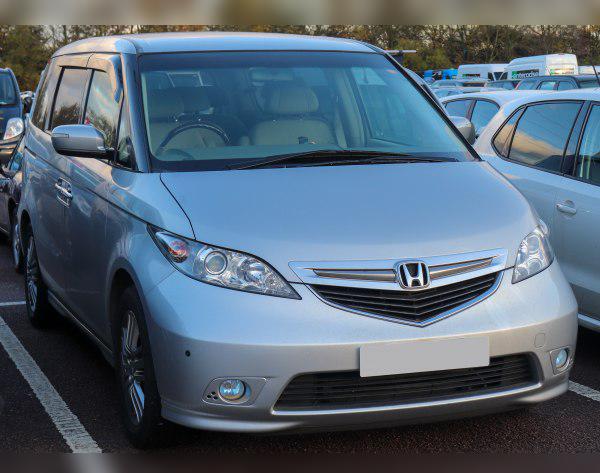
Honda J35A (3.5 V6) – Experiences, issues, fuel consumption and buying tips
1. Key points in short (TL;DR)
- Timing belt: The engine uses a timing belt that requires regular and not-at-all-cheap replacement (it is an interference engine).
- VCM system: Many variants of this engine deactivate cylinders to save fuel, which can lead to excessive oil consumption and vibrations.
- Power and refinement: The V6 configuration offers exceptional smoothness and torque, ideal for the heavy Elysion body.
- Transmission: The automatic gearbox is a sensitive point if the fluid is not changed regularly (Honda ATF is mandatory).
- Adjustable valves: There are no hydraulic lifters; valve lash must be adjusted mechanically.
- Fuel consumption: High in the city, don’t expect miracles, but surprisingly economical on the highway.
- Recommendation: An excellent engine for long-distance drivers and families who value quietness and comfort more than low maintenance costs.
Contents
- Introduction and applications
- Technical specifications
- Reliability and maintenance
- Specific parts and systems
- Fuel consumption and performance
- LPG and tuning
- Transmission and drivetrain
- Conclusion and buying advice
Introduction: A Japanese heart with American manners
The J35A engine series is Honda’s answer to the need for large, powerful and refined V6 powerplants. Although Honda is known for its high-revving four-cylinders, the J-series was designed primarily for heavier vehicles (MPVs, SUVs) and markets that value torque, such as North America, as well as specific JDM (Japan Domestic Market) models like the Honda Elysion.
In the Elysion, this engine’s job is to provide a “magic carpet” driving feel – quiet, linear acceleration without effort. With 205 hp (in this specific variant, although the J35 often goes up to 300 hp), the focus is on durability and comfort rather than racing performance. This is an engine for gentlemen and large families, but it requires an owner who understands that a V6 demands specific care.
Technical specifications
| Parameter | Value |
|---|---|
| Engine code | Honda J35A |
| Displacement | 3474 cc (3.5 L) |
| Configuration | V6, SOHC (single cam per head), VTEC |
| Power | 151 kW (205 hp) |
| Torque | 297 Nm |
| Fuel injection system | PGM-FI (multi-point indirect injection) |
| Induction type | Naturally aspirated |
Reliability and maintenance
Timing belt or chain?
This is a key piece of information: the Honda J35A uses a timing belt, not a chain. It is an interference engine, which means that if the belt snaps, the pistons will hit the valves and the engine will suffer catastrophic damage. The major service must be done strictly on time. The recommendation is every 100,000 km to 120,000 km or every 5 to 7 years, whichever comes first. When replacing the belt, you must also replace the hydraulic tensioner (a weak point that can fail prematurely), the water pump and the idler pulleys. The cost of this service falls into the category: Expensive (depends on the market).
Oil consumption and the VCM system
This engine takes approximately 4.3 to 4.5 liters of oil (with filter). The recommended viscosity is 5W-20 or 5W-30. As for oil consumption, this is where we get to one of this engine’s peculiarities. Many J35 versions in the Elysion are equipped with the VCM (Variable Cylinder Management) system, which deactivates 3 cylinders while cruising to save fuel.
Symptoms and issue: When VCM is active, the cylinders that are “shut off” cool down, and the piston rings do not seal perfectly, which leads to oil entering the combustion chamber. Because of this, this engine can consume oil. Consumption of 0.5 liters per 3,000–5,000 km is often tolerated on VCM engines, but you must regularly check the dipstick. VCM can also cause excessive vibrations that destroy the engine mounts.
Most common failures
In addition to the aforementioned oil leaks at the VCM valve or oil seals, the following are common:
- Valve adjustment: The J35 does not have hydraulic lifters. The valves must be adjusted mechanically every 40,000–60,000 km (or when you hear “ticking”). If this is ignored, the valves can burn, especially if you run the engine on LPG.
- Oil leaks: Often from the valve cover gasket or from the oil filter housing (VTEC solenoid).
- EGR valve: Prone to clogging with soot, which causes rough running.
Spark plugs
Being a petrol engine, it uses iridium spark plugs. The replacement interval is long, usually around 100,000 km. However, on the cylinders that are deactivated by the VCM system, the plugs can fail earlier due to oil deposits (so-called fouling).
Specific parts (costs)
Fuel injection system and turbo
This is a classic naturally aspirated engine with indirect (MPI) injection. There is no turbocharger, no supercharger. That’s great news for longevity – one (expensive) worry less. The injectors are very reliable and rarely cause problems, unless extremely poor-quality fuel is used. Injector cleaning is done preventively at high mileage.
DPF, EGR and emissions
Since it’s a petrol engine, it has no DPF filter and no AdBlue system. This drastically reduces maintenance costs in city driving compared to diesels. It has catalytic converters (usually two primary and one secondary). There is an EGR valve and, as mentioned, the intake manifold passages connected to the EGR can clog, which is solved by physical cleaning (not expensive, but it does take mechanic’s time).
Dual-mass flywheel
This model comes exclusively with an automatic transmission, so it does not have a conventional dual-mass flywheel like manual diesels. Instead, it has a torque converter. It is a durable component, but its replacement or overhaul is expensive if the transmission fails.
Fuel consumption and performance
City driving and highway
Don’t fool yourself – a 3.5-liter engine in a heavy Elysion (over 1.8 tons) has to use fuel.
- City driving: Real-world consumption ranges from 13 to 16 l/100 km. In heavy traffic and winter, it easily goes higher.
- Highway (130 km/h): Here the VCM system and aerodynamics (despite the “boxy” shape) help. Expect around 9 to 11 l/100 km. At 130 km/h the engine runs at low revs (usually around 2,200–2,500 rpm), which makes the drive extremely quiet.
Is the engine “lazy”?
With 297 Nm of torque, this engine is not lazy. It’s not a sports engine that will slam you into the seat in an aggressive way, but it has that feeling of “endless power”. It climbs highway inclines without the gearbox needing to kick down two gears. It’s more than adequate for overtaking, but it does require a decisive push on the throttle for VTEC to “come alive”.
Additional options and modifications
LPG conversion
Yes, it’s possible, and given the fuel consumption, very desirable. However, Honda J-series engines have relatively “soft” valve seats. If you are installing LPG:
- A quality sequential system with OBD connection is mandatory.
- A valve lubrication system (so-called “valve saver”) is recommended.
- Crucial: You must shorten the valve clearance inspection interval to every 30,000 km! If you ignore this, you will destroy the cylinder head.
Chip tuning (Stage 1)
On a naturally aspirated petrol engine, chip tuning doesn’t make much sense. Gains are minimal (maybe 5–10 hp) and you won’t feel a dramatic difference in driving. It’s better to invest the money in quality maintenance or tyres. There are “VCM Muzzler” devices that permanently disable the VCM system – this slightly increases fuel consumption, but significantly extends the life of the engine mounts and reduces oil consumption.
Transmission
Type of gearbox and maintenance
The J35A in the Elysion is most commonly paired with Honda’s 5-speed automatic transmission. Honda automatics from this period are specific. They are not classic planetary automatics like those from other manufacturers, but work similarly to manual gearboxes with hydraulic clutches.
- Maintenance: Transmission fluid should be changed every 40,000 to 60,000 km.
- Important: Use only genuine Honda fluid (ATF-DW1 or the older ATF-Z1). Universal ATF fluids can cause shuddering and slipping.
- Failures: The most common issue is torque converter overheating and “confused” shifting at low speeds if the fluid is old. There is no dual-mass flywheel as in manuals, so there is no clutch kit replacement cost, but overhauling the automatic is very expensive (often over 1000 EUR).
Buying used and conclusion
When buying a Honda Elysion with the J35 engine, pay attention to the following:
- Proof of timing belt replacement: If there is none, immediately factor that cost (parts + labour) into the car’s price.
- Valve noise: While the engine is idling cold, listen for metallic ticking. If it’s loud, the valves are out of adjustment.
- Vibrations: Put the gearbox in “D” and hold the brake. If the car vibrates strongly, the active (hydraulic) engine mounts are worn out (a common issue due to VCM) – they are very expensive.
- Test drive: The gearbox must shift imperceptibly. Any jerking, especially from 1st to 2nd gear, is a sign of trouble.
Conclusion:
The Honda J35A is a fantastic piece of engineering that offers the luxury of V6 motoring. It is not the cheapest to maintain (major service, fuel consumption, registration due to displacement), but it is extremely reliable if not neglected. It is intended for drivers who want maximum comfort on long journeys and are willing to pay for quality. If you’re looking for a cheap city runabout, skip it. If you’re looking for the king of the road in the MPV class – this is the right choice.